
Exceptionnelle

Exceptionnelle
2025-05-04T22:00:00Z
Start price: $20,000
Estimated price: $20,000 - $2,000,000
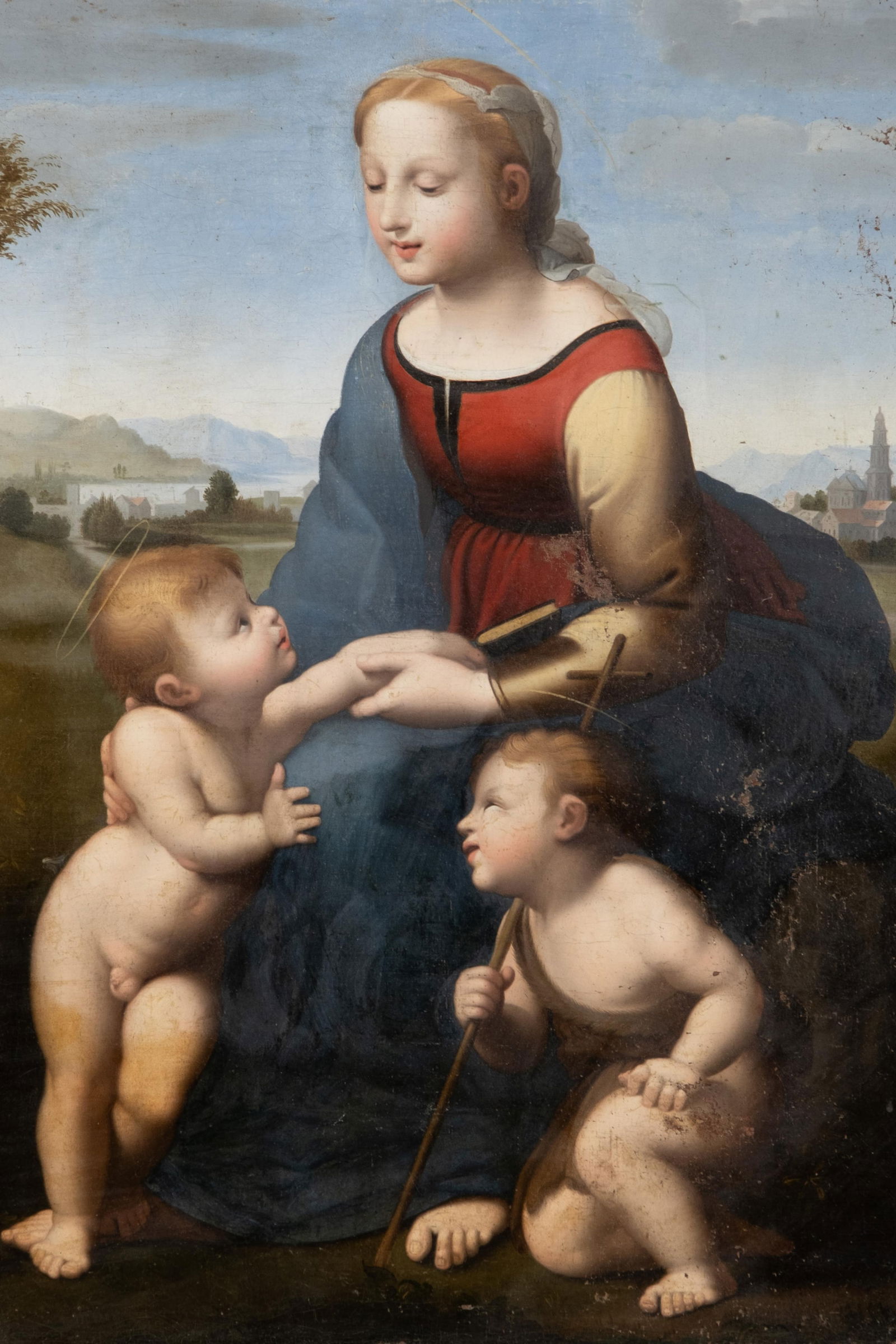
Lot 188:
Description
Keywords: High Renaissance, Italian Renaissance, Old Master painting, Raphael workshop, Madonna and Child, St. John the Baptist, Louvre variant, La Belle Jardiniere, Uffizi Collection, undiscovered masterwork, art conservation, 19th-century restoration, oil on canvas, comparative composition, religious art, Virgin and Child, devotional painting, hidden original, circle of Raphael
Exceptional and historically significant oil on canvas painting, attributed to Raphael (Raffaello Sanzio, 1483–1520) or his students. Its very close to the composition known as La Belle Jardiniere (The Beautiful Gardener), currently in the Louvre Museum.
Auctioneer Note:
We believe that this work is either another version or a preliminary version of the work known as “The Beautiful Gardener, ” created either by Raphael himself or possibly by or with one of his students. A review of the attached video will demonstrate that, in comparison with the known authenticated and accepted version, there are several significant and some more nominal differences in the form and structure of this painting. Notably, the landscape, foliage, and sky, among other nuanced differentiations, suggest that this work is not merely a copy (it’s close but different from the known version) but must be another finished variant created by the artist or a preliminary work.
This is an interesting event. The work is truly exceptional and nuanced. It was initially mis-cataloged as a 19th-century copy of a well-known Raphael work. The original work was held in the Uffizi Museum Collection and, more recently, the Louvre (known as “The Beautiful Gardener”).
The initial cataloged description had dated the subject work based on the visible 19th-century canvas. However, this canvas was only the substrate backing for older canvas upon which the artist’s work was originally made. When the last 19th-century restorer began the restoration work, it was discovered that parts of the actual original painting had been hidden. Some of that original was still present and had been carefully folded under the exposed visible painting. It had been concealed for many years beneath the visible painting.
When it was removed from its then supporting structure, the restorer discovered more of the original painting rolled under the painting’s stretcher. The real original painting was actually older and had been larger. The restorer, undoubtedly excited and very skilled. This is not a common occurrence. The restorer carefully unfolded the delicate hidden parts of the original painting, carefully remounted the entire complete work, and stabilized it on a new substrate lining.
The previously hidden parts of the painting are now visible and securely attached to the new lining. That 19th-century restorer must have attributed great significance to the discovery and considered the painting important because this restoration and remounting, which exposed and preserved the previously hidden original parts of the painting, required great skill, patience, and expertise. It is highly significant that those original parts, which had been concealed for years, were brought forward into view as they were found—without being touched up or repainted. A comparison of this work with the known work currently in the Louvre reveals that this work is not a copy. Although very similar in composition, it differs in several ways, and artists frequently made more than one variant of a work. This was especially true when a patron requested and was willing to commission a painting. More research and laboratory work will be required to verify.
A copyist would simply replicate and not make the creative changes that distinguish this as a different painting, which at first glance resembles the known painting. A 19th-century copyist certainly would not create a larger painting and then fold parts of the work into and under the stretcher. A skilled restorer would not expose these folded-under parts of the work, leaving these discovered relics of the painting untouched and without in-painting where pigment was missing—unless the importance of this work dictated that preserving the original artist’s paint was more important than the work’s appearance.
The work must have been considered so significant that even artifacts of old paint and work by the painter were deemed very important to preserve the work’s integrity, history, and authenticity.
Measurement: 33 1/2 x 30 1/4 in. (85.1 x 76.8 cm.) Approx
ID 10
Condition: Link to comparison video: https://youtube.com/shorts/cmmGHwuB-Fc
We strive to provide clear, detailed photographs of every item so you can bid with confidence. While condition reports are not available for every lot, please know that all items are sold as is, and light wear consistent with age and use should be expected. If you’d like more specific information about a particular piece, we’re happy to help—just reach out at least 24 hours before the auction begins.
Share this lot: